Rooting hormones are recommended for rotting plant cuttings. To help you decide if you need them, and which ones to select, it is useful to know more about them. In this post I will provide back ground information about rooting hormones. In future posts I’ll show you how to use them.
As a gardener we all talk about humus. Some of us even buy humus soil, and humic substances like humic acid and fulvic acid. We add compost to gardens to increase the humus level in our soils in the belief that humus is good for soil. Good garden soil is dark because of the high humus content.
If there is one thing all gardeners agree on, it is that humus is good for the garden – right?
Maybe not!
Science now says our beliefs about humus may be wrong. In this blog I will review some earth shattering news – or is that soil shattering news?
Humus Does Not Exist – Says New Study: The Contentious Nature of Soil Organic Matter, by Johannes Lehmann & Markus Kleber, published in Nature
There are several different methods for starting seeds indoors that work well for vegetable seeds and flower seeds. In this post I will review the various seed starting methods and help guide you in selecting the right method for your situation.
None of the seed starting methods are right or wrong – they all work and produce results. Each method is the best when it is matched to the right type of seed and the correct home environment. Learn about the best germination method for both vegetable seeds and flower seeds.
Goniolimon tataricum is a special plant that is not grown for its flowers, but it is grown for its dried flower head. It makes very small flowers which are hardly noticeable. When the flowers fade and the petals drop, you are left with a dried flower head that is spectacular. In fact it is so nice the plant is grown for the cut flower industry.
Many people are against synthetic chemicals and will not consider products like DEET. As I have reported before in DEET- is It Safe?, DEET is quite safe but many still do not believe the facts.
In the last couple of weeks the Zika virus has been all over the news. The World Health Organization has declared Zika virus a ‘public health emergency’ of international concern.
Which mosquito repellents work best against Zika? Are any of the organic products recommended? It is time to have another look at the mosquito problem.
In a previous post, Seed Dormancy – Explained, I discussed different types of seed dormancy and briefly discussed various seed pre-treatments. In this post I’ll provide you with a series of steps that you can follow to germinate just about any seed.
As winter approaches, we worry about our poor plants making it through the cold. All manor of wrapping devices are used to protect them and Styrofoam cones, also called rose cones, have become popular in recent years. Do these contraptions work? If they do, how much warmer do they keep your plants?
There is a lot of talk on the internet about Styrofoam cones. Many extension offices recommend them, and suppliers certainly tell you they work, but I was unable to find a single source of information that actually provided data to support the idea that Styrofoam cones keep plants warmer in winter.
So I decided to do some testing of my own.
Temperature changes with and without a Styrofoam Cone, by GardenMyths.com
Days to maturity, or days to harvest, is a number that can be found on most annual flower and vegetable seed packets. What does days to maturity mean? How can you use the number to grow more food and flowers in your garden?
Days to maturity is a very useful tool for selecting the right variety of seed and gardeners, especially in colder climates, should understand the term. This is even more important if you grow a vegetable garden.
Days to Maturity for tomato varieties, by Robert Pavlis
Organic Gardening – What is it? This should be a simple question, and many of you may think you know the answer, but the answer is more complicated than you think.
I consider myself an organic gardener – but some of you won’t agree because I do use some Roundup.
Can you garden organically and still use Roundup? Can you be ‘sort of’ organic and still consider yourself an organic gardener? Do organic gardeners make the best environmental choices?
Pseudofumaria lutea (formerly Corydalis lutea), by Robert Pavlis
Imagine a perennial that has no pest problems, and blooms from spring until frost, with fabulous yellow flowers. Pseudofumaria lutea (formerly called Corydalis lutea) is that plant. Because of its long bloom time it is one of my top perennials.
Allium moly is a plant that most people do not recognize as being an onion or garlic. It is short with fairly wide leaves unlike most onions. It also has very vibrant yellow flowers. This great garden plant should be in every garden. It grows just about anywhere, sun, shade, wet or dry – but maybe not in a bog.
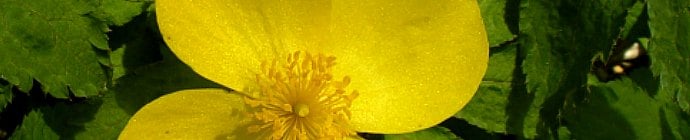
Hylomecon japonica is a special, collectors plant for the shady garden. It is rarely offered for sale, and seed from most seed exchanges will provide the wrong seed. This is a plant that is certainly worth hunting down.