

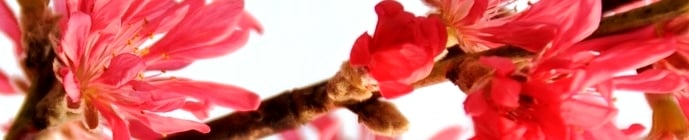
Prunus ‘Marion Jarvie’ has a mysterious past. Around 1997, a well known Toronto gardener, Marion Jarvie, obtained a small rooted cutting from Japan. The cutting grew into a fine specimen tree which produced a very unusual flower display. The colour is very bright and the petals are narrow, more like a Magnolia ‘Royal Star’. It became the highlight in Marion’s spring garden.

The original cutting did not have a name. The best guess is that it belongs to the species Prunus persica, a peach from north-west China. The flowers of this species have 5 petals. Since Marion’s tree has more petals than this it is more likely to be the flore plena version; flore plena meaning double flowered.
The tree proved to be very popular and everyone who saw it wanted one. A few years ago Tom Intven of Canadale Nurseries (St. Thomas, Ontario) was kind enough to propagate it and make it available commercially. This year it was available at several area nurseries as a top grafted standard.

In honour of the person who discovered the tree, it is now called Prunus persica flore plena ‘Marion Jarvie’. Commercially it is being sold as Prunus ‘Marion Jarvie’, since there is still some doubt about the exact species name.
 This small spring flowering tree seems to be topping out at 15 feet. The commercially available standard can be easily pruned to a smaller size so that it fits even small gardens. It will grow and flower in part shade but seems to do better in full sun. It seems to be hardy in zone 5 and has even survived a couple of winters in zone 4b. The flowers are sterile and therefore do not produce fruit.

This is a very special tree that will fit most gardens and is available in limited quantities.
Prunus ‘Marion Jarvie’
(PROO-nus PER-see-kuh)
Life Cycle: tree
Height: 5 m (15 ft)
Bloom Time: spring
Natural Range: China (for the species)
Habitat: unknown
Synonyms: none
Cultivation of Prunus ‘Marion Jarvie’:
Light: part shade to full sun
Soil: good drainage
Water: average moisture
USDA Hardiness Zone: 5 (maybe 4b)
Propagation: grafting, cuttings



My trees also produce fruit, since I purchased a second one
I have 2 of these which are in the 6th yr. They are over 20 ft tall and 15 ft wide. And this after much pruning. The fruit is small almond shaped and this yr the trees are full of fruit, over 100 pcs per tree.
Thanks very much for posting this.
I’ve had two of these for about 5-6 years now. They’re doing fantastic in my garden (zone 5b) and grow quite robustly. Although they’re listed as sterile, mine often produce a few fruit which I leave to ripen on the tree. I’m convinced this is an almond tree variety since the fruit is small and resembles an almond in every way and it splits when mature, just as an almond does. I also find the blossoms are more reminiscent of and almond rather than a peach tree.
I agree. I have 2 and I water them during the summer when needed. They are both in full sun.
IHave had my Marion Jarvie tree for two years now,i agree the flowers are attractive in spring,however as the warmer weather increases the leaves curl and fall off leaving the tree very sparse and parhetic looking,ideas!
Does it need more water?
They don’t do that for me in zone 5.